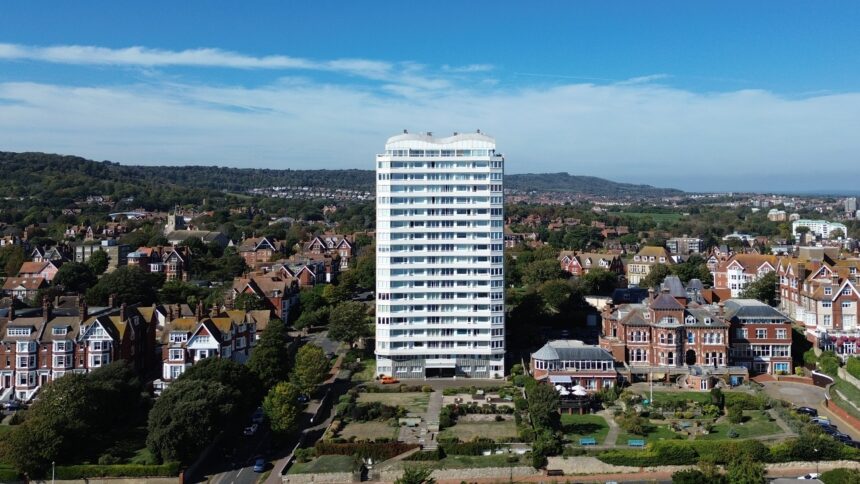

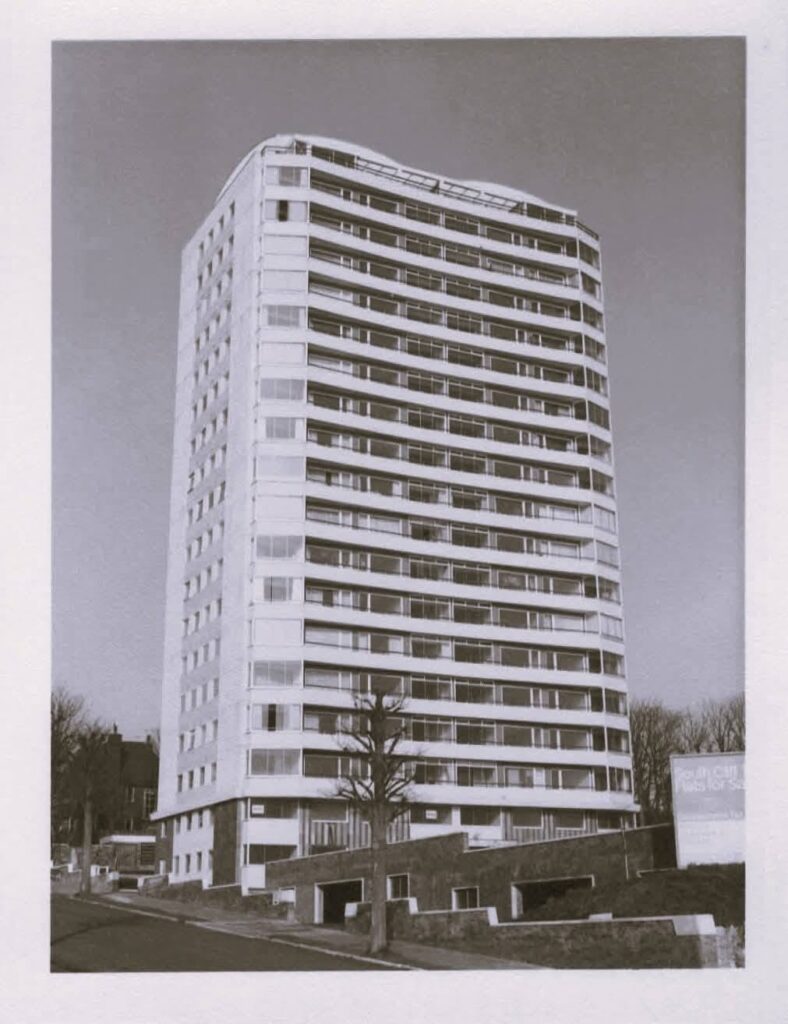
THIS year marks the 60th anniversary of the opening of South Cliff Tower, a landmark building that has attracted both praise and controversy since it was built at the height of the 1960s trend towards high-rise living and modernist architecture.
The tower was built on the site of Hillcote, in Bolsover Road, Meads, a former school for girls that was built in 1894 but closed in 1939 and was converted into flats.
The owner of Hillcote, Katie Underhay, was a local businesswoman with an international background, born in Chile in 1901. She moved to Sussex in 1938 and was elected as one of the Councillors for Meads ward in 1951, one of just a few female Councillors at that time.
Cllr Underhay has often been linked to the story of how South Cliff Tower was developed but the facts seem to show that after selling the site to a London-based developer called Site Improvements (Eastbourne) Ltd, she had no say in what kind of building was built on the site.
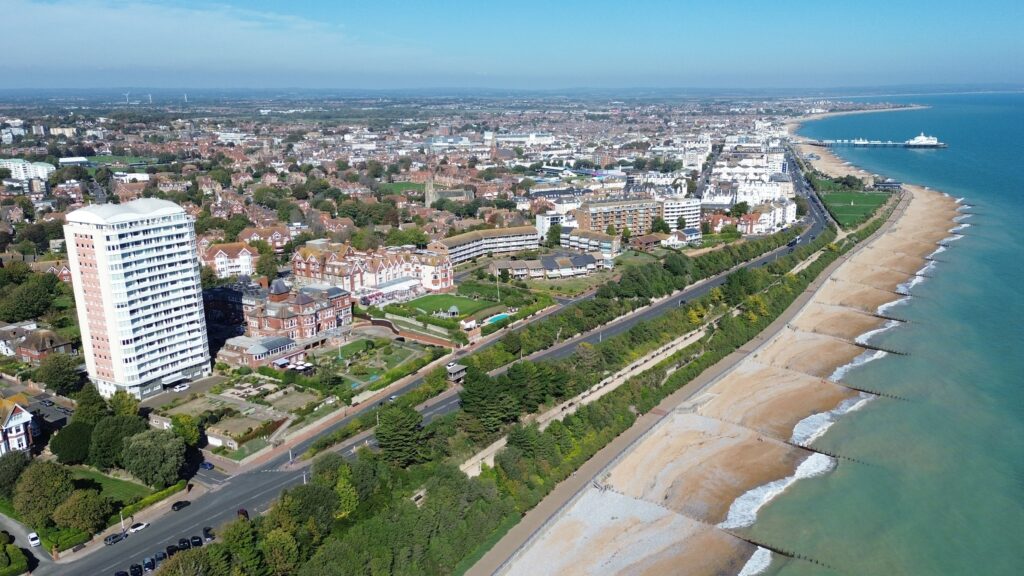
The real story of South Cliff Tower is how Eastbourne embraced modernism and its first high-rise block but did it in a different way from most towns, with a block of flats aimed at high-earners, set in the most prestigious part of the town.
Origins and Opposition
The first proposal to redevelop the site was submitted to the Council in February 1960. There was considerable opposition to the plans and there was much debate amongst the planners and Councillors and in the letters pages of the local papers. At the time there was a national discussion about how people should be housed and in the late 1950s Britain saw a rapid growth in high-rise tower blocks, particularly in city centres and in areas which had been badly bombed during the war.
Eastbourne was not one of the places that had extensive areas of war damage to replace, but the Council was keen to attract new people to come to live and work here and was worried about falling behind other towns in the southeast.
New suburbs and new industrial estates were developed in Hampden Park and Langney, with employers such as Birds Eye moving to the town. The opening of the Congress Theatre in 1962, the largest concert venue on the south coast, was evidence of the Borough Council’s ambitions for the town. In April 1960, the Mayor of Eastbourne, Alderman John Howlett, said that he wanted to see investment in Eastbourne including a ‘Millionaire’s Mile’ of ten-storey tower blocks built all the way from South Cliff to the foot of Beachy Head. Not everyone agreed with him!
In January 1962, the Council’s Planning Committee approved an application for a 58m tall, 19-storey block of 73 flats on this prominent seafront site. At the full Council meeting on February 5th 1962, this was approved by 17 votes to 11. The Chatsworth Settlement, representing the interests of the Devonshire Estates, raised no objections.
The vote in favour of South Cliff Tower was close but it was a clear majority, even if the vote didn’t necessarily reflect the views of Eastbourne residents, particularly those in Meads. There had been a heated debate in the Council and in the letters pages of the local papers but there’s no evidence of any underhand dealings to get the scheme passed. The modernisers, reflecting the spirit of the time, won the argument over the traditionalists.
Final planning consent was given in June 1963 and local firm Llewellyn’s was chosen as the main contractor for the project. By October 1964 a demonstration flat was ready for viewing on the ground in front of where South Cliff Tower would be built.
Feelings continued to run high in the Meads area. Katie Underhay, who had served as a Councillor for Meads since 1951, took a lot of the blame for the new development and in the elections of May 1966, she lost her seat to an Independent candidate, despite being the Mayor of Eastbourne at the time.
When South Cliff Tower was finished, Katie Underhay moved into Flat 17a on the floor below the penthouses, but it’s not clear whether this was part of the deal for her selling Hillcote or whether she was so committed to this new way of living that she embraced it wholeheartedly and chose to buy one of the flats.
Sales, Rumours and Reality
Work on South Cliff Tower continued and flats in the new block were marketed in London newspapers such as the Evening News, which advertised the two penthouses for sale at £27,000 each. In November 1965 Llewellyn’s removed the crane that had slowly but steadily built the tower block floor-by-floor around a central concrete pillar housing the lifts and service shafts.
In March 1966 the local newspaper carried an advert for porters at the new block and the first residents began to move in. In August 1966, the roof was opened up to local people to take in the view, perhaps more to improve local public relations than for marketing purposes.
The developers must have been concerned about whether there would be sufficient demand for these expensive new flats, but in August 1967 there was good news to report for the developers as the two penthouses had been sold to the same buyer, a former Lord Mayor of London, Sir Denys Lowson, who planned to convert them into a single residence.
In the same article, it was reported that 43 of the flats had been sold so occupancy was still only around 60%. But by the end of 1968 the agents, advertising in Country Life magazine, were offering the ‘few remaining flats in this outstanding block’.
Rumours abound that Roger Moore owned one of the penthouse flats but there’s no evidence for this. There’s no mention of the story in the local press until September 1999 when a throwaway comment in the Herald may have started this urban myth by saying that ‘at one time it was rumoured that the penthouse was home to Roger Moore’. If you have any evidence to show that he did own a flat there, then please let us know!
As we mark the 60th anniversary of the opening of South Cliff Tower, Eastbourne’s tallest building, it’s probably time to accept that although the building was the product of a particular time and would not be built in that way today, it has survived better than most of the high-rise flats built in Britain in the 1960s.
It was constructed from good quality materials and has been well-maintained by the relatively wealthy residents who have lived there. The flats are popular with buyers and the recent external renovations, including the addition of attractive terracotta stripes down the east and west sides, have helped the block fit more easily into its surroundings.
South Cliff Tower was built at a particular time in Eastbourne’s history when circumstances combined in favour of such tower blocks. More were planned, including a 15-storey block on the site of what is now Ravens Croft, next to the Hydro Hotel. This received initial planning permission before being rejected by the full Council in 1965, when it became clear to many that approving South Cliff Tower had been a mistake. There would be no more tower blocks on Eastbourne’s seafront.
Remarkably, after 60 years, South Cliff Tower still evokes strong opinions and, although local residents have learned to live with it, there’s no doubt that it will remain Eastbourne’s most controversial building for many years to come.