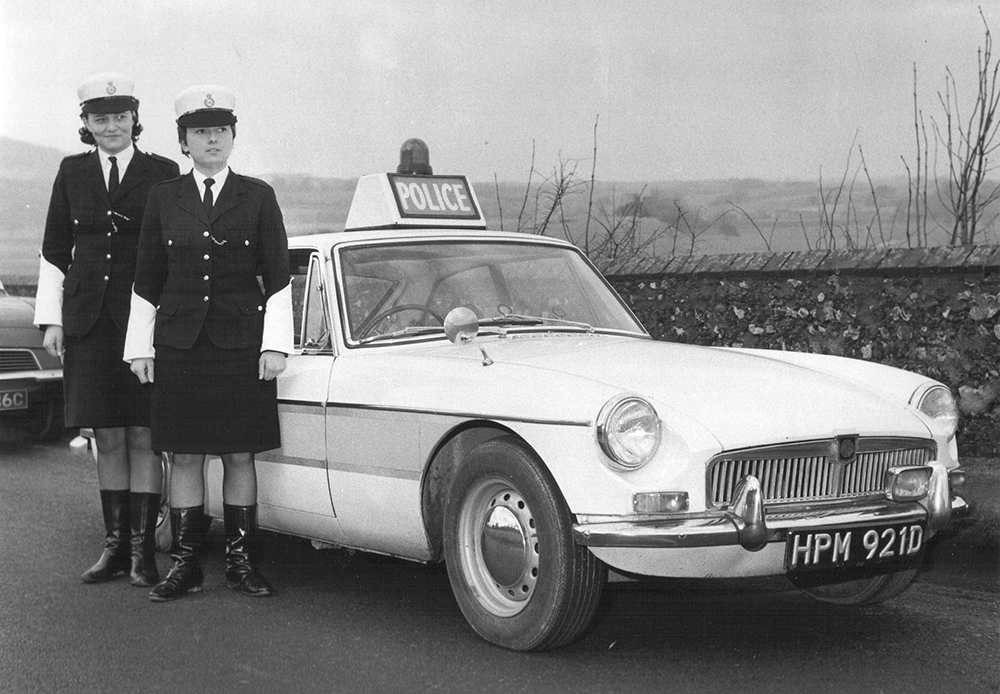

IN a landmark moment for British policing, two Sussex policewomen made history by becoming the first female officers in the country to qualify as Class 1 drivers on the elite Traffic Division.
At a time when women in uniform were still a novelty, they smashed through gender barriers on the roads, in the courts and behind the wheels of powerful patrol cars.
It all began in 1966, when Chief Constable Sir George Terry of East Sussex Constabulary made a decision that would shape the future of women in frontline policing.
Renowned for his progressive outlook and personal connection with officers, famously remembering everyone by name, Sir George had a particular passion for roads policing and the work of his female staff. His vision led to the purchase of MG BGT sports cars for traffic patrols and a groundbreaking idea of assigning a female crew to one of them.
The move was designed to make a statement. Not only did it promote modern policing, but it also placed women visibly at the forefront of operations. The two women selected were Hazel Lane (née Waters) and her colleague, Joy Parks (nee Christian), who was thrilled at the opportunity at the end of her two-year probation.

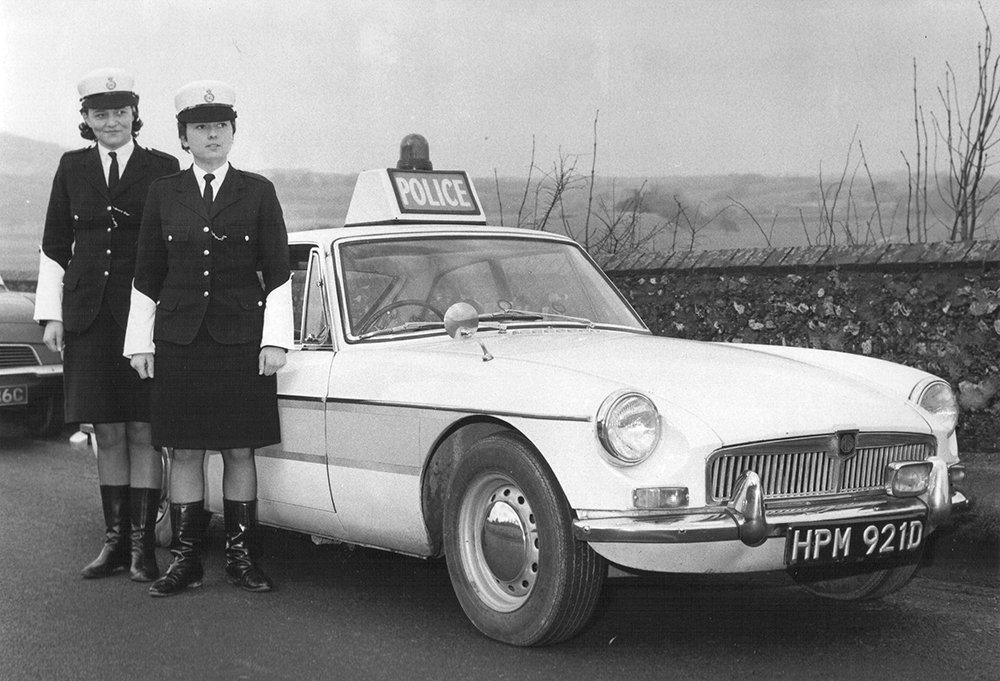
But before their boots hit the pedal, they were required to undergo a driving assessment with a senior traffic sergeant to prove they could handle the high-performance MGs.
Once approved, the pair became an instant talking point, not just within the force, but in the national press. Initially deployed across the county to promote East Sussex Constabulary’s new initiative, the women became minor celebrities, photographed and interviewed as the first female traffic crew in the country.
While the internal response was largely supportive, some press coverage was less progressive, branding them ‘Traffic Dollies’ and the ‘100mph Petticoat Patrol’.
Still, the public image of policewomen was evolving, and the two officers stood at the centre of it. Their unique role required additional preparation.
Before taking on full duties, they were mentored by a male officer at the T6 traffic base in Lewes and then sent to the Kent Police Driving School in Maidstone. There, they trained in powerful Jaguars, Humbers and Wolseleys – larger and more demanding than the MG BGT awaiting them back home.

The course included high-speed driving, vehicle handling and continuous running commentary, a technique still used today in advanced driving. Both officers passed with flying colours, achieving the coveted Class 3 standard, the highest level awarded at the time.
Back at Lewes, the pair were welcomed by male colleagues and fully integrated into the team. Their duties were no different from any other officer on the Traffic Division. They were first on scene at crashes, expected to deliver emergency first aid and were frequently called upon to assist in serious incidents.
By 1967, East Sussex Constabulary had become East Sussex Police, and a year later, all county forces were merged into what became Sussex Constabulary.
Amidst this backdrop of change, the two trailblazing women returned to Maidstone in 1969 to train for the prestigious Class 1 Police Driving Certificate, an even more advanced qualification involving theory, high-speed manoeuvres on skid pans and real-world hazard awareness.
Both passed again with top marks, making history as the first women in Britain to earn this elite certification.
Yet despite their equal workload and high-level achievements, they were not paid the same as their male counterparts, a situation that persisted until the Equal Pay Act came into force in 1975.
Their training extended beyond driving. They also completed the Traffic Patrol course, which covered vehicle mechanics, a skill that often came in handy when helping stranded motorists and traffic law. The Course included a visit to Maidstone Bus garage to learn the intricacies of diesel engines. a skill that often came in handy when helping stranded motorists.
The pair became qualified vehicle examiners, regularly giving expert evidence in court. Their technical know-how was matched by their field experience, which went far beyond ticketing speeding drivers.
On patrol, they were often first responders to emergencies ranging from burglaries and domestic disputes to suicides and knife threats. One memorable incident involved escorting an ambulance through traffic to rush a critically ill child to Brighton Children’s Hospital.
There were challenges, of course. Equipment and backup were limited. There was no real-time system to check if a vehicle was taxed, insured or stolen.
Instead, officers had to issue HORT1 forms requiring the motorist to produce documents at a police station of their choice. Vehicle and suspect checks had to go through the SUSCRO card index system based at Brighton, relayed via police radio.
Speed enforcement involved setting up speed traps using the PETA meter, a portable roadside device, and two radios. One officer would monitor and record a vehicle’s speed, then radio ahead to the second officer to flag down the driver.

Although the MG BGT was the most iconic of their vehicles, it wasn’t always the most practical. With the added weight of the police equipment and the size and shape of the roof box, manufactured in Lewes, it lost some of its speed, but our training always encouraged them to ‘make progress’. The pair also patrolled in Lotus Cortinas, both marked and unmarked as well as the hefty Ford Zephyr.
Inside the cars was a full kit of essential equipment: Bardic lamps, first aid kits, fire extinguishers, accident cones, roadside warning signs, a breathalyser, camera, tape measure, broom, chalk, handcuffs and blankets, often used in both emergencies and accidents.
Photographs taken at crash scenes were developed at police headquarters and included in formal reports. Monthly maintenance was required, and officers were expected to wash the cars, check tyres, and top up fluids themselves, sometimes even degreasing the engine bays with Gunk.
Uniforms, on the other hand, were a constant source of frustration. The skirts and summer dresses female officers were issued with were entirely impractical. White buttons on sleeves for their tunics were the only high-visibility items worn by all traffic officers.
Joy recalls one incident involving her climbing into a ditch to assist an injured motorcyclist, which proved to be an awkward and undignified manoeuvre in a skirt. On another occasion, a suspect fled through dense woodland after abandoning a stolen vehicle, but she couldn’t follow over the fence due to her uniform. Fortunately, a dog handler arrived to continue the chase.
Still, they enjoyed certain privileges that made them the envy of other female officers: smart calf-length leather boots and three-quarter-length driving jackets, a distinctive part of their Traffic Division identity.
Another aspect of their role was escorting abnormal loads, heavy haulage vehicles with wide or long loads. Unlike today, they were typically escorted from the front. Haulage companies sometimes phoned in special requests: ‘Can we have the girls?, a novelty at the time that added a touch of charm to the operation.
Not all reactions were positive, of course. Public perception of women in high-visibility police roles was still evolving. One memorable moment came when arriving solo at the scene of a serious accident near Lewes. A bystander’s reaction summed up the prevailing attitudes, when they stated: ‘Blimey, it’s a woman!’
But, over time, their competence won respect. Whether it was stopping lorries, handling dangerous situations, or managing serious road traffic incidents, these officers proved time and again that they were more than up to the job.
Looking back, the two pioneering women didn’t realise they were making history at the time. They simply got on with the job of driving, patrolling, responding, investigating, with professionalism and pride. But their legacy is still felt today.
Their trailblazing efforts helped open doors for generations of female officers across the country. They didn’t just rewrite the rulebook; they proved that women belonged on the frontlines of policing, behind the wheel of the fastest cars, responding to the most urgent calls.
Today, one of those iconic MG BGT patrol cars is preserved and proudly displayed by John Parks, Joy’s husband. It’s taken to car and emergency services shows around the area, and it never fails to attract interest.