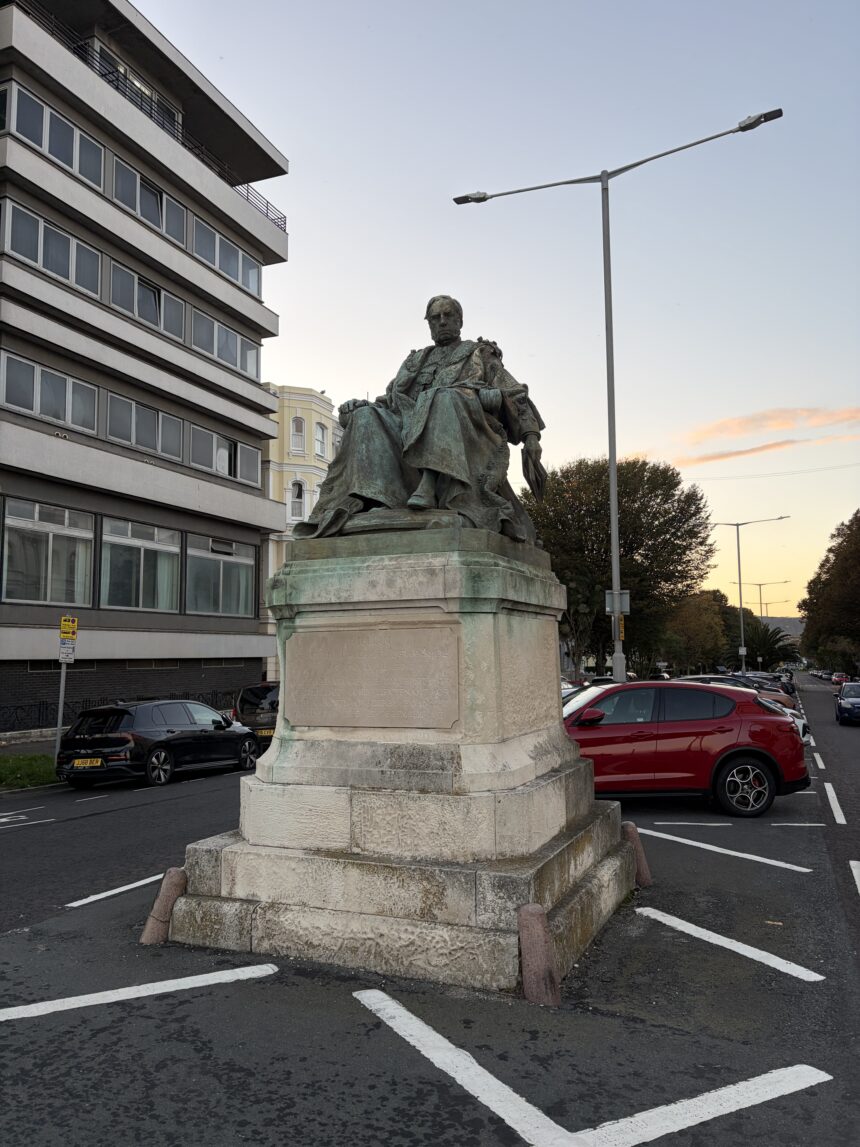
Unveiled 125 years ago, the statue at the sea end of Devonshire Place commemorates William Cavendish, the 7th Duke of Devonshire, the man who created the seaside resort of Eastbourne. The statue, by the sculptor William Goscombe John, was funded by subscriptions from the residents of Eastbourne and unveiled in August 1901, ten years after the Duke’s death.
Born in 1808, William Cavendish was the grandson of Lord George Cavendish, the 1st Earl of Burlington, and Lady Elizabeth Compton, heiress to Compton Place and to around 10,000 acres of land in what was then known as East Bourne. William’s father died young, in a carriage accident, and in 1834 he inherited the title and the land and hoped to create a seaside resort which, in his words, would be ‘by a gentleman, for gentlemen’.
Initially William lacked the money to make this happen but things changed quickly: Eastbourne’s first railway opened in 1849, just as the fashion for visiting the seaside was becoming popular amongst the wealthier classes, and in 1858 William inherited the title of Duke of Devonshire from his distant cousin, ‘the Bachelor Duke’. Despite only being the grandson of the 6th Duke’s great uncle, William was next in line to the title and became the 7th Duke of Devonshire. With all the resources and income that came with the Dukedom he was now one of the richest men in the country and could deliver his vision for Eastbourne.
William started by employing the architect Henry Currey to plan the new resort. Currey laid out wide, tree-lined streets and insisted on approving the designs of all new buildings. The resulting high-class houses and hotels on the seafront and in the adjacent roads and squares, attracted upper class visitors and residents to the town and created jobs for local people. Eastbourne’s rapid growth continued into the 1870s and 1880s, with the development of Meads as a residential area of large mansion houses.
Without the 7th Duke of Devonshire’s investment, Eastbourne would be a very different place. It was Devonshire money that paid for the sea walls that protect the coastline and for the town’s sewage and water systems and, later, the gas and electricity supplies. The Duke also gave the land for Devonshire Park and Eastbourne College and paid for the Winter Garden, the Western Parades and much else, all of which we still enjoy today. These investments were philanthropic but provided an income to the ducal coffers through the leasing of plots of land, the sales of the freeholds and the steady flow of dividends from the utility companies.
The Duke’s statue in Devonshire Place shows him holding a book, signifying his role as Chancellor of Cambridge University, a position that he held for 30 years. As a student at Cambridge, William had won prizes for maths and science and, throughout his life, he campaigned for better science education and for improved animal and crop breeding.
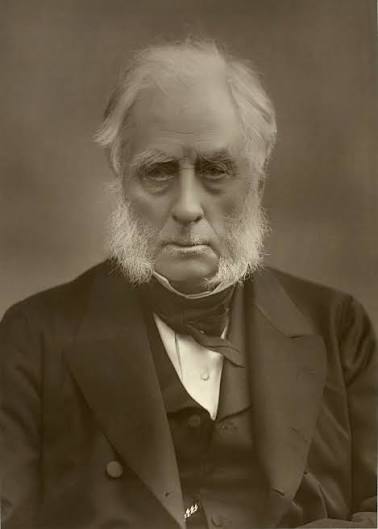
The statue of the Duke and the pictures we have of him, show him looking rather grumpy. This could be because he spent over 50 years as a widower following the death of his wife, Blanche, in 1840, at the age of 28. On April 27th, 1874, William wrote in his diary that, “today is the anniversary of my dearest Blanche’s death, 34 years ago. I am 66 today and it cannot be long before I follow her”. He lived for another 17 years but the death of his beloved wife, which happened on William’s 31st birthday, affected him greatly and, for him, could never outweigh his many achievements.
By the time the 7th Duke died, in 1891, Eastbourne was established as one of the premier seaside resorts in the country and was known as ‘the Empress of Watering Places’. His eldest son, Spencer Compton Cavendish, became the 8th Duke but by then Eastbourne had become a Municipal Borough, run by elected Councillors, and the Duke’s influence was declining. The Council retained the 7th Duke’s original vision for the town, however, and Eastbourne continued to grow and prosper during the twentieth century, becoming the town that we know today.
Walking around Eastbourne there are frequent reminders of whose town it once was. There’s Devonshire Park, of course, but also the Burlington, Chatsworth and Cavendish Hotels, the streets of Meads that are named after places that the Duke owned in Derbyshire, and Carlisle Road, named for his beloved wife Blanche, daughter of the Earl of Carlisle.
William Cavendish, the 7th Duke of Devonshire, lived a long and distinguished life and was acknowledged as ‘the patron saint of Eastbourne’ by the people who funded the statue unveiled in Devonshire Place 125 years ago. We continue to benefit today from William’s vision and from the investments he made in the town.