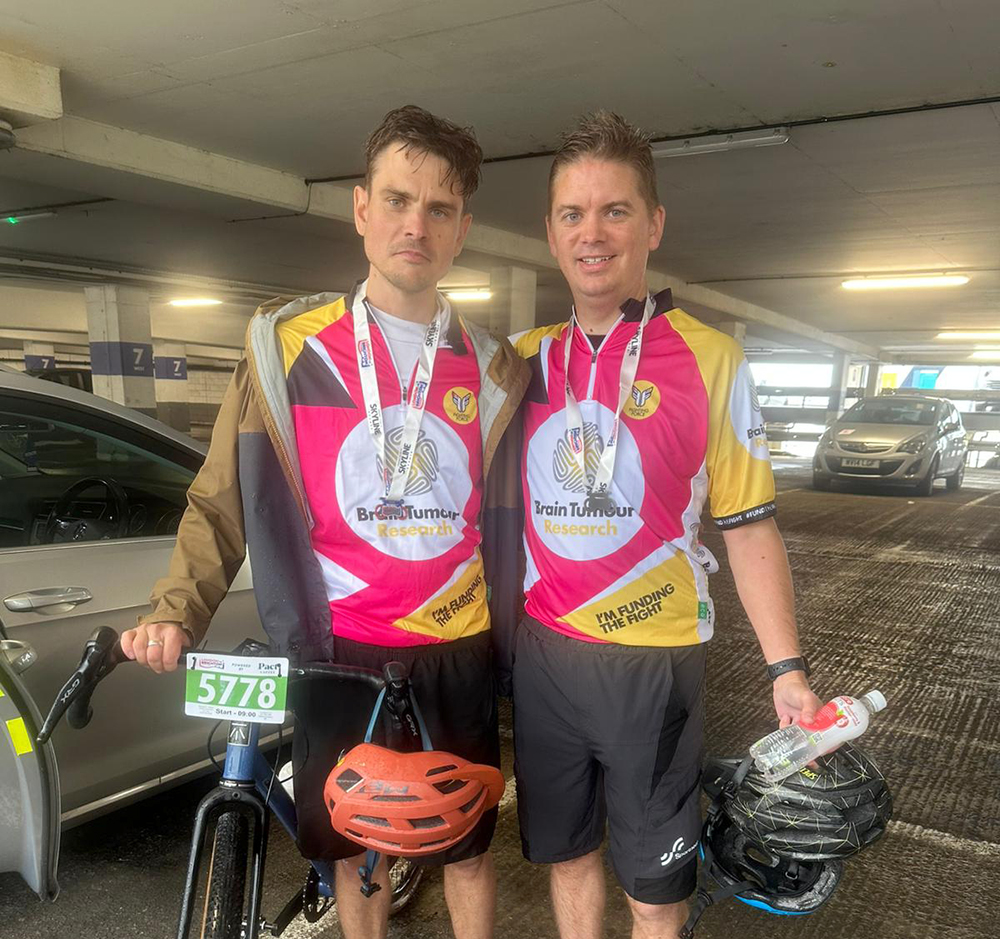
TWO brothers took on the London to Brighton Bike Ride in memory of their father, who lived with the long-term effects of a brain tumour for more than 30 years.
Dan Pitt, 38, from Eastbourne, and Alex, 34, from Brighton, rode the 54-mile distance in aid of Brain Tumour Research, raising more than £850.
Nick Pitt, 65, who lived in Eastbourne, died as a result of a catastrophic seizure in 2020, a side effect of a medulloblastoma he was diagnosed with aged 29.
After the seizure, a 14-hour operation, followed by combined radiotherapy and chemotherapy, left Nick with balance issues and complete deafness.
In May 2020, Nick experienced a series of seizures which were initially suspected to be transient ischemic attacks (TIAs), or ‘mini-strokes’. They were thought to be a late effect of the trauma caused to his brain by the tumour and its treatment. One seizure lasted almost three hours, after which he never recovered. He died weeks later in June in Ersham House.
Dan said the challenge was their way of remembering their father and providing hope for families and patients.
Dan said: “It feels great to have completed the ride in memory of our dad and for such a great cause, raising more than £850 for Brain Tumour Research.
“It was certainly gruelling at times. But we both managed to cycle the whole way and made it to the top of the infamous Ditchling Beacon without stopping.

“Alex and I were so lucky that, despite Dad having been diagnosed with a major tumour, he managed to live a very full and positive life for over 35 years despite the challenges he faced. This challenge was our way of remembering our dad, whilst providing hope for future families and patients facing this devastating disease.”
Speaking about the diagnosis and the impact on the family, Dan said: “Dad’s diagnosis had a huge impact on our family, especially my mum, who spent her entire married life with him living on edge as he coped with so many side effects.
“We were fortunate he was able to have a career in banking, raise a family, see me and Alex grow up, and even meet one of his grandchildren – but many patients don’t get that chance.”
Dan who is dad to Oliver, seven and Halle, five, said: “Although Dad never had a recurrence of his tumour, the treatment left a lasting mark. His mobility was affected, so he relied on a walker, and we all learned fingerspelling to help with communication. Despite these challenges, he never complained and remained incredibly positive throughout his life.”
Brian Tumour Research says that brain tumours kill more men under the age of 70 than prostate cancer and the number of brain tumour diagnoses has increased by 11 per cent in the last decade.
Dan added: “One in three people knows someone affected by a brain tumour, yet just one per cent of the national spend on cancer research has been allocated to brain tumours since records began in 2002. As a family, we feel strongly about changing that and want to help keep more families together for longer.”
Dan added: “Since dad’s death, we’ve come to understand that the type of brain tumour he had is very rare in adults and doctors don’t know what contributed to his long survival.
“It’s vital that new treatments are made available which allow patients to live fully and with fewer side effects. We saw how those side effects gradually chipped away at dad, and although we had more time with him than some, eventually it caught up with him.”
Charlie Allsebrook, community development manager at Brain Tumour Research, said: “We’re so grateful to Dan for sharing his dad’s story and for taking on this challenge with his brother in his memory.
“Funds raised will support vital research at the charity’s Centre of Excellence at Queen Mary University of London where scientists are working on personalised treatments for brain tumours such as medulloblastoma.
“The support of families like Dan and Alex’s is crucial in helping us advance research that will provide better options for patients and their loved ones.”
For more information visit www.braintumourresearch.org.