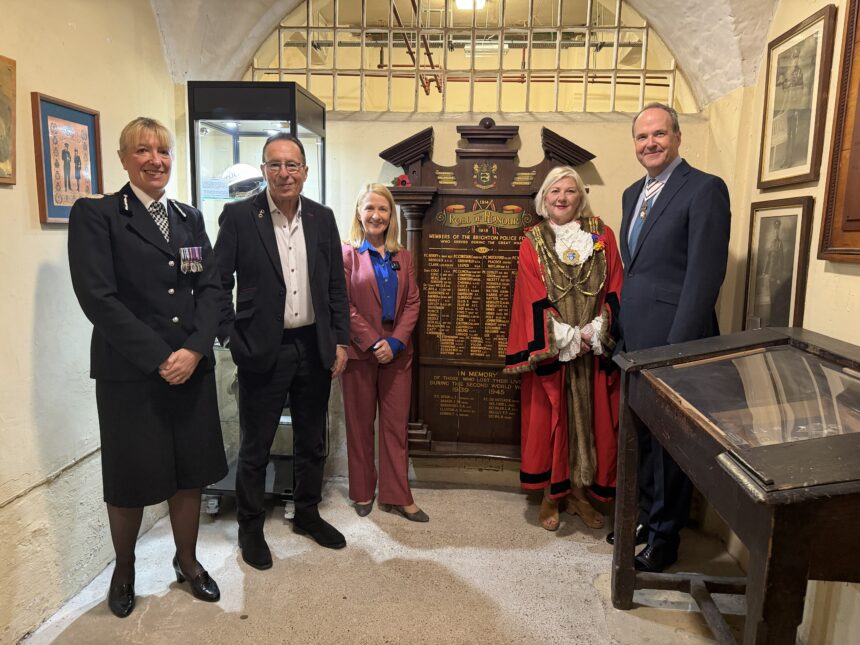
As Sussex Police and Crime Commissioner, I am privileged to meet people from every corner of our county who care deeply about local history, community identity and preserving the stories that shaped the places we call home.
That is why I am delighted that the Old Police Cells Museum beneath Brighton Town Hall has reopened to visitors following a major revival project, ensuring this remarkable collection can be enjoyed by future generations.
As the museum’s new custodian, I have taken on responsibility for safeguarding this unique part of Sussex’s policing heritage and securing its long-term future.
Many people assume the museum tells only Brighton’s story. In fact, it tells the story of policing across the whole of Sussex. Hidden beneath the Town Hall are original Victorian cells that were in use from 1832 until 1967, alongside fascinating artefacts, photographs, uniforms and records charting nearly 200 years of policing history. Visitors can discover the story of the murder of Brighton’s first Chief Constable, Henry Solomon, explore original cells complete with historic graffiti, and learn how policing has evolved through the decades.
For readers across East Sussex, one part of the museum is especially worth seeking out. Among the exhibits is a dedicated East Sussex cell, helping to bring to life the history of the former East Sussex Constabulary and the officers who served communities from Eastbourne and Bexhill to Crowborough, Hailsham and beyond. The collection includes artefacts connected to East Sussex policing, reminding us that today’s Sussex Police was built on the proud traditions of local forces that once served towns and villages across our county.
I know many residents enjoy discovering local connections to wider history, and that is exactly what the museum offers. Whether you have a family member who served in the police, an interest in crime and justice or simply enjoy uncovering hidden gems, there is something here for everyone.
What makes the museum particularly special is the atmosphere. These are not recreated cells or modern interpretations. They are the original holding cells, charge rooms and custody areas where countless real stories unfolded. Walking through the corridors is like stepping back in time and experiencing Sussex’s history first-hand.
The museum also has an important role to play in helping younger generations understand our shared history. Looking at how policing has changed over almost two centuries opens up conversations not only about crime and justice, but about how society itself has changed and the relationship between the police and the public they serve.
That is why I am particularly keen for schools across Sussex to make use of the museum as an educational resource. A visit offers pupils the opportunity to step outside the classroom and experience history in a very tangible way, standing inside original police cells and seeing first-hand the objects and records that tell the story of policing in their own county.
For teachers, the museum offers the potential to enrich learning around local history, social history, citizenship and the changing role of public services. It can also encourage pupils to think about how communities, laws and attitudes have developed over time and what public service means today.
I would love to see schools from across East Sussex and beyond visiting the museum and helping us to inspire a new generation to take an interest in the heritage on their doorstep. For some children, it may be their first opportunity to discover just how much local history lies behind buildings and places they may already know.
The museum is, of course, not just for schools. It makes a fascinating visit for families, community groups, local history enthusiasts and anyone looking for something a little different to explore in Brighton.
Guided tours are led by knowledgeable volunteers, many of whom have policing or local history backgrounds, who bring the exhibits to life through fascinating stories and personal insight. It is this combination of an extraordinary setting and the knowledge of those who care for it that makes a visit so memorable.
As custodian, I want the Old Police Cells Museum to be more than somewhere we preserve the past. I want it to be a living educational resource that connects people across Sussex with their local heritage, encourages curiosity and ensures these stories continue to be told.
If you are a teacher considering a future educational visit, a family planning a day out, or simply someone with an interest in Sussex history, I would encourage you to discover it for yourself.
You can find out more and book a guided tour through the Old Police Cells Museum website: www.oldpolicecellsmuseum.com.
You may be surprised by just how much of your local history is waiting to be discovered beneath Brighton Town Hall.